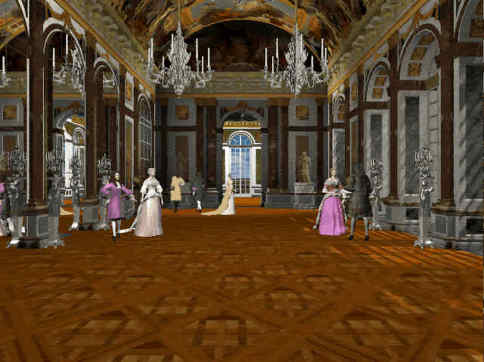
This being said, my focus of interest is still archaeology and history. The kind of games that I would like to make would use historically rigorous models, real stories and characters, and would be educational. I recall a game that I played during childhood and illustrates quite well what I have in mind. It's called "Versailles 1685" and I remember finding it very interesting at the time. What I liked about it is that it takes place in Versailles palace and you get to walk around its different rooms and areas, view and read about its paintings, meet many historical characters and learn about them and about life in the palace. Here some images of the game:

So now it's easier to know what I need to learn. I searched for job offers in serious games and game development in general, and the key skills that I will need are C++ and Unity 3D. Besides this, most of the offers require professional experience in game development, with at least one published game, and about half of them require to have a master in game development. Therefore I've been considering signing up for one of the two main masters in video game development that exist in Barcelona:
From the one taught by UPC I like that it's cheaper and as a UPC Alumni Premium member I get an additional discount :-D Also they use game engines, which would be useful to learn (I guess), and the master has for some reason more visibility among companies. The annual event in which students present their works is always full of people.
The one by UPF is more hardcore. They don't use any game engines and instead expect you to implement your own. I see it as a great learning experience. Another good thing about it is that they split the contents into two independent specializations: design and programming. That means that programmers can focus on just programming and skip the modelling and animation part. Finally, the amount of classroom hours is higher.
I was almost convinced by the one at UPF but a conversation with my boyfriend and several other friends who are professional game programmers walked me out of it. In their opinion masters are too expensive for the benefit they provide, and game companies don't care much about the education section after all. Companies value experience and motivation. Since I'm already a developer they believe that I can learn the same or more on my own. So their piece of advice is that I keep my money and start making copies of simple games or join an indie group. I just need to have a few small projects in my portfolio, know the main concepts in game development and be well versed in the language. And if they all agree on that then I guess they're right.
Next stop: becoming an indie game developer.

No comments:
Post a Comment